 Creator of JenneTastic®
A daycare day moves through arrivals, play, snacks, personal care, outdoor time, rest and departures. Children experience these moments through sound, movement, touch, light, smells and relationships. When something becomes uncomfortable, they may need adults to change the activity, help them communicate or offer a manageable pause. A useful sensory support makes an ordinary part of the day more accessible; it does not have to turn the program into a therapy room.
Reviewed October 2, 2026. This English guide focuses on daycare and early learning, particularly everyday care and play for preschool children. JenneDesign sells JenneTastic, which is the first product discussed below. Product information describes its intended use, not proof that it treats a condition. The practical scenarios are hypothetical examples for planning, and the photographs illustrate situations rather than document customer outcomes.
You will find guidance for educators, home childcare providers, directors and families: how to notice a specific difficulty, select an adjustment, organize adult support and decide whether it helps. Individual health needs, developmental concerns and feeding difficulties require appropriate professional input. Start with the child and the activity, then consider the room, routine and equipment. Keep opportunities for play, relationships and belonging at the centre of each decision.

In this guide
Begin with a moment that matters to the child
Observe without turning an impression into a diagnosis
Make age and developmental fit part of every decision
JenneTastic first: a supervised preschool pause space
Introduce a pause before anyone urgently needs it
Make arrivals manageable for children and families
Build an open quiet area that still belongs to the group
Support play without prescribing how enjoyment must look
Offer alternatives within sensory and art activities
Use music and group gatherings with room for choice
Adjust background sound through ordinary room routines
Make snack and mealtimes comfortable to join
Treat handwashing and personal care as shared routines
Keep awake pauses separate from sleep arrangements
Prepare dressing and outdoor transitions before the queue forms
Choose outdoor participation options that fit the activity
Make changes of activity understandable rather than abrupt
Help children communicate choices before speaking is easy
Plan peer participation without making one child the lesson
Build a family partnership around specific information
Make the routine understandable to every educator
Consider the realities of home childcare
Keep materials clean, complete and ready to use
Buy a useful resource rather than a complete sensory collection
Read evidence without confusing education with a product trial
Review participation and change course when needed
A practical checklist for the next care day
Questions families and daycare teams often ask
Build a daycare day that children can take part in
Begin with a moment that matters to the child
Choose a recognizable part of the day before choosing a product. Perhaps a child wants to build with friends but leaves when several children crowd around the block shelf. Perhaps they arrive comfortably but struggle while waiting beside the noisy hand dryer. These are different situations. Describing the moment allows the educator to examine what happens immediately before, during and after it, instead of treating the entire daycare day as one problem.
Write the goal in ordinary language. A child might need to find a place at the snack table, join a favourite painting activity or reach their coat without being jostled. The goal is not simply to sit still, stop objecting or appear calm. A useful adjustment should make the activity more manageable while preserving the child's ability to express a preference. That gives adults something concrete to review together.
A hypothetical example makes the distinction clear. Four-year-old Maya enjoys building roads, but the block area becomes crowded during morning free play. The team could first offer a second tray of large blocks at an adjacent table and invite one familiar peer to join her. They would then observe whether she can reach materials and enjoy building. Buying a whole collection of sensory equipment would not answer the initial question as directly.
Identify what will count as a worthwhile result before making the change. Maya might play for a comfortable period, ask a peer for a block or choose to return after a break. She may still prefer a quieter location. The review should respect that preference rather than reward a performance that looks typical. If the arrangement does not help, the team has learned something about access, not discovered that the child failed an intervention.
Observe without turning an impression into a diagnosis
Describe what you can actually see or hear. A note such as “covered ears when the blender started, then moved beside the door” is more useful than “had a sensory meltdown.” It records the event without claiming to know its cause. A child may also be tired, unwell, worried about separation or confused about the next step. Keep several possible explanations open until the family and relevant professionals can help clarify them.
Observation can be brief and purposeful. Record the activity, the surroundings, the child's communication and the adult response. Include successful moments: the same child may tolerate snack preparation when the blender is used before children arrive, or enjoy the room when there are fewer competing conversations. Looking only at difficult moments can hide the conditions that already support participation and lead adults to describe the child too narrowly.
Use everyday language that the family recognizes. Instead of presenting a list of deficits, say that the child enjoys particular materials and finds a particular part of the routine uncomfortable. Invite the family's interpretation and ask whether the situation is familiar elsewhere. Different responses at home and daycare do not mean either account is wrong. The spaces, people, expectations and timing may differ considerably, and those differences can guide practical adjustments.
Do not build a program around a diagnosis the child has not received. Educators can offer considerate environmental changes and support communication while assessment is being considered. If a difficulty persists, substantially affects daily activities or raises a health concern, discuss the next steps through the program's established process. The purpose of documentation is to support a constructive conversation, not to make a clinical conclusion or create a permanent label from one hard morning.
Make age and developmental fit part of every decision
A mixed-age childcare setting cannot treat every sensory product as suitable for every child. Consider the manufacturer's age guidance, the child's ability to use the item, and the youngest children who might reach it. A preschool room may share an entrance, storage area or outdoor route with toddlers. Equipment that appears appropriate during one activity can become unsuitable if it is later left accessible to a younger group.
For infants and younger toddlers, this guide's preschool product examples are not an equipment plan. Start with responsive care, safe age-appropriate surroundings and the child's established care instructions. Discuss individual concerns with the family and relevant professionals. An activity that works for a four-year-old who can ask for a break may not suit a child who communicates through movement, gaze or vocal sounds and needs different adult support.
Age suitability is necessary, but it does not settle every question. Two children of the same age can differ in how they explore objects, move through the room or understand directions. Ask whether the item can be used safely and meaningfully by this child in this setting. If the adult must spend the whole activity preventing misuse, a simpler alternative may be more useful than an elaborate product that technically meets an age label.
Revisit the decision when the group changes. A new child, a room move or an afternoon mixed-age arrangement may alter access and supervision. Keep unsuitable items in secure adult-managed storage, and make the boundary clear to substitutes and visitors. A centre's purchasing list should distinguish preschool resources from infant and toddler resources so that familiar branding does not become an assumption that every item belongs in every room.
JenneTastic first: a supervised preschool pause space
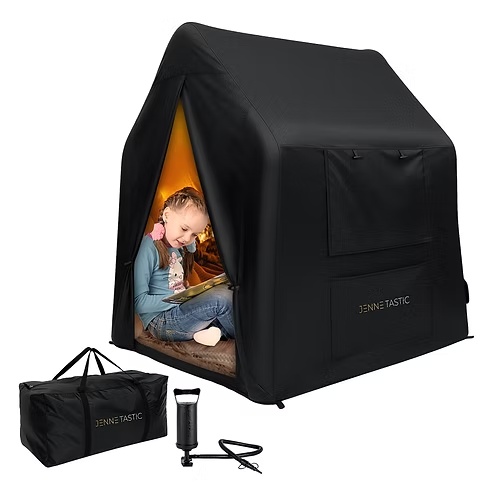
JenneTastic's portable sensory tent offers a defined indoor space that can be set up and stored as the room's needs change. The verified guide specifies ages three and older, adult supervision and a clear exit. The kit includes the tent, a manual pump, carrying bag and bilingual guide. An adult operates the pump. These are practical product characteristics; they do not establish a clinical benefit or guarantee that a child will prefer the space.
Consider it when a preschool child would welcome a temporary, clearly defined place to pause while an adult remains responsible nearby. For example, a program might introduce it during a quieter part of the day, explain its purpose simply and allow the child to explore without pressure. The first question is whether the arrangement fits the child and room. It should not be presented as the mandatory response to every difficult transition.
The user guide describes the space as optimal for one child, with room for two children or an accompanying adult when needed. Capacity does not replace a supervision plan. Placement must be stable, indoors and away from heat, sharp objects and busy routes. The entrance and exit remain clear. JenneTastic is not intended for sleep or active play, and a daycare should keep its nap arrangements separate from this awake pause option.
Before purchasing, read the current guide and review where staff would install, inspect, supervise and store the tent. Consider whether children can access and leave it comfortably, whether the educator can maintain oversight of the group, and what alternative is available if a child declines it. For the daycare-specific context, see JenneTastic for daycares. A thoughtful introduction matters more than treating the product as an automatic solution.
Introduce a pause before anyone urgently needs it
An unfamiliar space can add uncertainty when a child is already having a difficult moment. Introduce the pause option during an ordinary, settled part of the day. Show what it is for, where the adult will be and how the child can leave. Use a short invitation and allow observation from outside. Some children will want to approach slowly; others may prefer a familiar open reading spot instead.
Give the routine a small number of recognizable steps. An educator might offer a choice between looking at a book nearby and taking a supervised pause in the designated space. The child can indicate a preference in their usual way. Afterward, the adult offers a clear next activity rather than an abrupt instruction to rejoin everything happening in the room. The goal is a usable routine, not a test of how independently the child can calm down.
Avoid making access contingent on a child becoming visibly distressed. A child who requests a pause early is communicating something useful. Equally, do not send a child to the space simply because an adult finds their behaviour inconvenient. If the child does not want to use it, the team needs another way to help. The physical space is one option within the program's care, and it cannot replace attentive adult support.
A hypothetical introduction could happen while two educators are present and the rest of the group is engaged in familiar play. One adult demonstrates the space, then offers the child an opportunity to look without requiring entry. Staff note the child's response and agree on the words they will use next time. This small rehearsal can reveal practical problems, such as a confusing invitation or awkward placement, before the routine is used during a busy arrival.
Make arrivals manageable for children and families

Arrival contains several changes at once: separation from a parent, outdoor clothing, a different sound environment and the start of group care. Look at the sequence rather than assuming the difficulty is separation alone. A child may manage the goodbye well but find the congested cubby area uncomfortable. Another may need time to recognize which educator is receiving them. The first adjustment should address the part of arrival that is actually difficult.
Agree on a simple handover with the family. Decide where the child enters, who greets them and how important information is shared without a long conversation over the child's head. A familiar first activity can give the child a clear destination: selecting a book, arranging large blocks or greeting one peer. Make the destination available before the child arrives, rather than promising an activity that staff still need to retrieve.
Try to separate adult administration from the child's welcome. Forms, payment questions and nonurgent discussions can be handled through the program's usual channels. An educator should not have to divide attention between a detailed conversation and helping several children settle. If a family needs a longer discussion, arrange it deliberately. A predictable welcome is easier to maintain when the staff know which information must be exchanged immediately and which can wait.
In a hypothetical home childcare setting, one child arrives while another family is leaving. The provider might ask families to use an agreed handover location and keep the child's first materials on a nearby low shelf. This does not eliminate every emotional response to separation. It simply reduces competing demands at the doorway. Review the arrangement with the family after several arrivals, including whether the greeting feels welcoming rather than rushed or impersonal.
Build an open quiet area that still belongs to the group
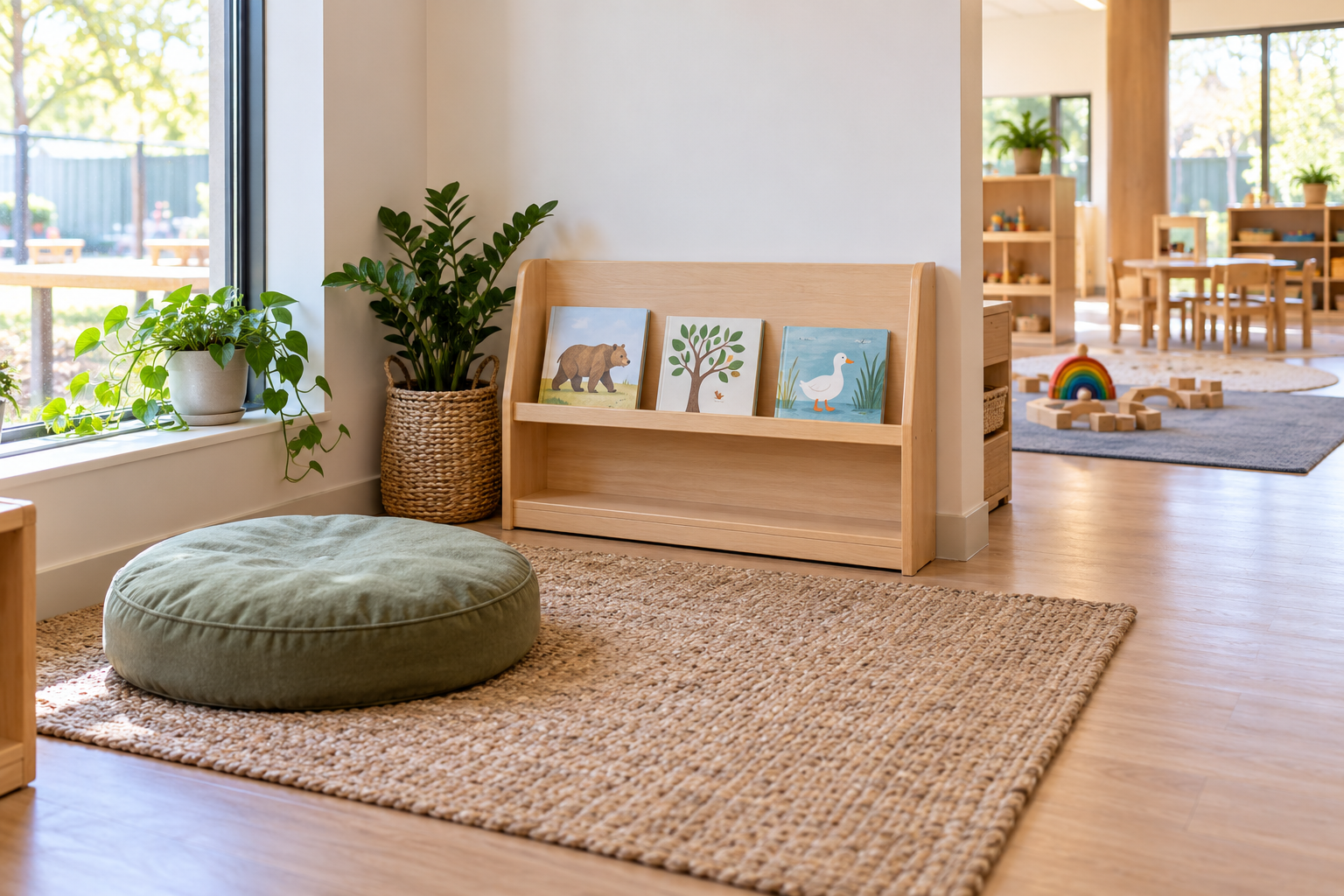
A quiet area should feel like part of the daycare, not a place where a child disappears from its social life. Start with a modest arrangement: a stable seating option, a few accessible books and a location away from the busiest movement route. The area can offer a different pace without being completely isolated. Keep the adult's ability to observe and assist central to the layout, rather than choosing a visually impressive corner first.
Think about how the area will be reached. A child should not have to pass through a crowded construction game to access a quieter place. Furniture should not create an unexpected obstacle for another child or interfere with ordinary movement. An open arrangement may suit a program that cannot accommodate a tent or needs a pause option accessible to children who prefer greater visibility. The appropriate design depends on the people and space.
Limit materials initially. Too many cushions, decorative lights, toys and textures can turn a simple reading spot into another place with competing demands. Offer a small selection that can be cleaned and maintained within the program's routines. Ask whether each item helps the intended activity. A book the child can handle comfortably may contribute more than an attractive accessory whose purpose the staff cannot explain.
Keep the invitation flexible. Some children may use the area to look at a book with an educator; others may sit briefly and watch nearby play. Staff can support a return by preserving the child's materials or offering a manageable way to reconnect with a peer. Review whether the area remains available as intended. If it becomes overflow storage or a favourite place for loud group play, the original support has changed and needs attention.
Support play without prescribing how enjoyment must look
Children can participate in play in different ways. Watching a peer, arranging materials alongside someone or joining for a short exchange may be meaningful involvement. An adult should first understand the child's interest before insisting on a particular social performance. The task is to make play accessible and inviting, while helping everyone use materials safely and respectfully. A child does not need to enjoy every texture or group activity offered by the program.
Look at the entry point. A busy pretend kitchen may be easier to join if the educator offers a familiar role with a manageable amount of equipment. A construction area may need more reachable blocks rather than a lesson about sharing. A child who cannot comfortably handle a small puzzle piece might enjoy a larger puzzle with an appropriate grip. These adjustments preserve the activity's purpose while changing how the child can take part.
The educator's involvement should serve the play rather than dominate it. Offer enough help to make the next step understandable, then allow the child room to choose. For example, an adult can place two large blocks within reach and model an invitation to a peer, without directing every exchange that follows. Notice whether adult commentary itself becomes distracting. Sometimes an attentive presence and a brief prompt are more useful than continuous instruction.
A hypothetical preschooler loves watching others build towers but moves away when adults ask them to explain their work. The educator could invite them to hand a block to a familiar peer or build alongside the group without a verbal presentation. Review whether the child enjoys the opportunity and whether peers have a clear way to include them. This is a play-access decision, not an assumption about the child's language ability or a promise of a developmental outcome.
Offer alternatives within sensory and art activities

A sensory activity is an invitation to explore, not a requirement to tolerate an unpleasant sensation. Decide what the activity offers: mark-making, sorting, experimenting with movement or sharing an experience. Then provide more than one practical way to engage. If the goal is making marks, a child may use a brush rather than touch paint directly. If the goal is exploring a material, observing first may be a useful beginning.
Keep choice straightforward. Present a small number of manageable options instead of a crowded tray full of unfamiliar textures. Explain what will happen and where cleanup materials are available. Allow a child to stop without turning the decision into a confrontation. Staff can describe the choices neutrally, so using a tool does not become a lesser version of the activity or a public sign that the child is different.
Screen materials for the group using them. Online sensory-play recipes may include small loose objects, foods or substances that do not fit the children's ages, allergies or exploration habits. Follow the program's safety and hygiene procedures rather than assuming a popular activity is appropriate. A large washable tool and ordinary approved art material may be a more workable choice than a complicated homemade mixture whose handling and cleaning requirements are unclear.
In a hypothetical painting session, an educator prepares two broad brushes and paper at the same table as the fingerpainting invitation. One child chooses a brush, another touches the paint and a third watches before deciding. The adults can support each route toward the shared creative activity. They should not describe successful participation only as eventually putting hands into paint. The review concerns access, interest and a manageable experience, not forced exposure.
Use music and group gatherings with room for choice
Songs, stories and group gatherings can be enjoyable, but the combination of close seating, adult voices and instruments may be demanding for some children. Examine the gathering's purpose. A short shared song does not require every child to sit in the same position or handle the loudest instrument. Make room for a different place to listen, a quieter contribution or a brief visit that can grow if the child wants it to.
Prepare the activity before gathering everyone. Retrieve materials, check the volume of recorded sound and decide where children can sit without crowding. An educator who searches for supplies while the group waits may unintentionally extend the most difficult part. Use a clear opening and ending so children can understand the sequence. The activity should remain meaningful even when a child participates from the edge or joins with another adult nearby.
Choose instruments and sound levels deliberately rather than offering every item at once. A small group can take turns with a limited selection while another group has a different activity. This is one way to reduce competing demands without removing music from the program. Ask families about familiar songs or ways their child enjoys listening, while recognizing that the daycare group may create a different experience from music at home.
A hypothetical educator notices that a child enjoys the greeting song but leaves when several shakers are distributed. The team could try a song without instruments first, then offer a smaller instrument activity later. They would compare the child's response to those parts rather than claim that music generally overwhelms them. If an individual hearing or sound concern requires specialist guidance, seek it through the family instead of using a general blog suggestion as an assessment.
Adjust background sound through ordinary room routines
Separate sound required for the activity from sound that is simply happening nearby. An educator reading a story may compete with a recorded playlist, a noisy cleanup task and conversations at the entrance. Removing an unnecessary background source can be more useful than asking the child to manage every sound independently. Begin with changes adults can make without depriving other children of an enjoyable and active program.
Notice when noise builds. The busiest periods may be the overlap between snack cleanup and free play, or the wait before outdoor time. A small timing change can prevent several tasks from occurring in the same area at once. Staff can also consider whether frequently moved furniture needs approved maintenance or whether a loud piece of equipment can be operated away from the activity. Review these choices within the centre's practical constraints.
Sound supports that a child wears require individual thought. Check the item's fit, age guidance and purpose, and whether the child can still receive important communication. A headset should not become the default answer to a room that adults could make easier to use. If the child dislikes it or staff are uncertain about its use, consult the family and relevant professional. Keep the focus on the particular activity rather than a blanket promise of better concentration.
For example, a hypothetical program discovers that its dishwasher starts while the quiet book group is beside the kitchen door. Moving the reading group or changing the appliance's timing may be possible. The staff should first confirm that either adjustment works with meal hygiene and supervision. This kind of practical scheduling decision can address a specific conflict without introducing equipment, and it gives the team a clear change to evaluate.
Make snack and mealtimes comfortable to join

Start with the seating and sequence, not with a demand to eat a particular food. Can the child reach the table comfortably? Is the place easy to find? Does a long wait occur after children sit down? A meal combines social interaction, smells, sounds, textures and physical tasks. Identify the part that needs support instead of treating every difficulty as a feeding problem or assuming that eating more is the only useful outcome.
Prepare the table and adult roles before inviting the group. Make age-appropriate utensils and cups available, and ensure seating suits the child and activity. Consider whether serving arrangements create crowding or repeated reaching across another child's space. Staff can provide a clear beginning and a manageable way to ask for help. Changes should fit the program's established food safety procedures, allergies and any individual care instructions.
Do not use a sensory activity as a shortcut into feeding treatment. A child's distress around food, swallowing difficulty or significant feeding concern needs the appropriate professional pathway. Families and educators should coordinate what is offered and how concerns are communicated. Avoid unapproved changes to food texture or therapeutic equipment based on a general article. A calm table routine can support access to a meal while leaving individualized feeding decisions with qualified professionals.
In a hypothetical snack routine, a child becomes upset during a ten-minute wait while the adult finishes preparation. The centre could prepare more of the task before children sit and introduce a short predictable invitation when food is ready. It would review whether the waiting problem improves and whether the change remains manageable for staff. The child may still prefer certain foods; that is a separate question, and the centre should not promise the routine will resolve it.
Treat handwashing and personal care as shared routines
Personal care can require close contact, unfamiliar sensations and several instructions in quick succession. Explain the next step in a way the child understands, and give them a practical role where possible. For handwashing, that might mean approaching the sink, choosing between available approved soap dispensers or asking for help with a sleeve. An understandable sequence is more useful than repeated commands issued while another child is waiting immediately behind them.
Look at the physical arrangement. Check whether the child can reach the approved washing setup safely and whether the waiting area leaves enough room to move. Keep required supplies ready so the adult can attend to the child. If a particular sound or sensation is uncomfortable, discuss a suitable alternative within hygiene requirements. The goal is to maintain care while making its delivery more considerate, not to omit an essential hygiene step.
Diapering, toileting and clothing changes also require privacy, dignity and the program's safeguarding procedures. Avoid turning intimate care information into a public sensory chart. Share only what relevant staff need to provide appropriate care through the centre's established system. Families may have useful language or a familiar sequence that can be adapted to the setting. Individual pain, skin concerns or other health issues should be addressed through the proper care pathway.
A hypothetical child hesitates because the adult begins wiping before explaining what is happening. The team could try a short consistent explanation, prepare the needed materials and allow the child an appropriate small role. Staff would look for signs that the sequence is clearer and less hurried. They should not interpret every objection as avoidance of touch, particularly when discomfort, illness or an unmet need may require attention.
Keep awake pauses separate from sleep arrangements
Daycare rest time and a temporary awake pause serve different purposes. A child may need a slower activity before rest, but that does not make every quiet product a sleep space. JenneTastic is not intended for sleep. Do not place a child in the tent for a nap or transfer nap equipment into it. The program should maintain its approved rest arrangements and any individual instructions separately from its sensory pause options.
For babies, Health Canada's safe sleep guidance for every sleep applies at home and in childcare. It describes placing babies on their backs and using a suitable firm, flat sleep space free of soft objects and extra bedding. A sensory product, adult chair or improvised padded corner is not a substitute. Follow current guidance, product instructions and the program's established safe sleep procedures for the children in its care.
For preschool children, review the transition into the program's rest routine. Staff can make the sequence understandable, reduce unnecessary background activity and identify an appropriate option for a child who is awake, within the centre's requirements. A quiet book activity may need a separate arrangement so it does not disturb children who are sleeping. This is a scheduling and supervision decision, not a recommendation to change a child's individual sleep plan.
A hypothetical preschool room finds that cleanup noise continues after the rest transition begins. The educators could complete the loudest tasks earlier and prepare the next awake activity in advance. They should review whether the arrangement works for both resting children and those who remain awake. Any persistent sleep concern deserves a conversation with the family and relevant professional; the centre should not advertise a sensory corner as a treatment for sleep difficulties.
Prepare dressing and outdoor transitions before the queue forms

The move outdoors can turn a pleasant activity into a long period of waiting, crowding and handling clothing. Map the actual sequence: collecting coats, changing footwear, receiving help and reaching the door. The difficult part may be a crowded bench or an unclear instruction rather than the outdoors itself. Where the staffing arrangement permits, organize the sequence so children are not dressed too early and then expected to wait in a congested area.
Place each child's materials where staff and children can find them without repeated searching. A familiar order can help: locate the coat, sit at the approved changing place, receive the needed assistance and move to the next supervised position. Use photographs or simple cues if they are meaningful to the child. Avoid adding a detailed display that becomes another task to understand while everyone is already preparing to leave.
Coordinate with the family about clothing that is suitable for the weather and manageable for the child. An item may be difficult because of fit, fastening, discomfort or unfamiliarity. Ask before making assumptions about texture. The centre can describe what happens during the routine and discuss practical alternatives without giving medical advice. Keep spare clothing organized and identify how it is labelled, maintained and returned so a missing item does not disrupt the next transition.
In a hypothetical group, two children need adult help with boots at the same time that others gather beside the exit. The educators could prepare the support order and supervised waiting activity before dressing starts. They would review whether children have enough space and whether the routine still meets the centre's supervision needs. The aim is a workable departure, not a competition to dress quickly or a reason to criticize a child who needs assistance.
Choose outdoor participation options that fit the activity
Outdoor play offers different experiences from an indoor room, and a child may welcome some while finding others uncomfortable. Examine the activity and conditions. A noisy wheeled-toy area, unfamiliar ground surface or crowded slide entrance may require different adjustments. Do not assume that being outside automatically creates a calming experience. Keep attention on what the child wants to do and which part of the environment limits their participation.
Offer a manageable entry point without separating the child from the program by default. An educator might invite a child to begin with a familiar large-ball game beside one peer, observe an activity before joining or use an accessible route to a preferred area. Prepare the materials and adult position in advance. Any arrangement must preserve the program's outdoor supervision, boundaries and ordinary safety procedures.
Remember that the product discussed here is for indoor use. Do not move JenneTastic outdoors as a shortcut to providing a quiet option. Instead, consider appropriate outdoor choices that the program can supervise: a less crowded activity, a different time within the planned sequence or adult help understanding how to join. Weather, sun protection and equipment suitability remain part of the centre's normal outdoor planning rather than becoming secondary to a sensory idea.
A hypothetical child enjoys carrying large garden tools but avoids a crowded pretend construction game. The educator could offer a similar purpose with suitable materials in a nearby supervised area, then provide an invitation to connect with another child. Review enjoyment and access, rather than counting how long the child tolerates the busiest zone. The preferred arrangement may change with the activity, and the child's choices should remain part of the decision.
Make changes of activity understandable rather than abrupt
A transition asks a child to stop something, recognize the next activity and move through the room. Prepare for each part. A warning that free play is ending may help one child but mean little to another unless they can see what happens next. Match the cue to the child's understanding: a familiar object, a photograph, a brief spoken explanation or a gesture the family and educators already use.
Protect a meaningful ending where possible. A child who has built something may want it left intact, photographed under the program's consent procedures or stored in a safe agreed place. A child painting may need a clear place to put their work. These are practical ways to close an activity without asking the child to abandon its purpose suddenly. Staff should avoid promising preservation if the room cannot support it safely.
Have the next activity ready. A transition becomes harder when children leave one task only to wait for the adult to prepare another. Decide who organizes materials and who supports the children moving between areas. If the program has one provider, simplify the sequence so essential preparation happens before the transition begins. Predictability depends on adults making the routine workable, not only on children remembering a posted schedule.
For example, a hypothetical child objects when block play ends because they do not know whether their road will be removed. An educator could agree on a small designated display area and explain the next activity with a familiar picture. Staff would review whether the child can finish and move on with less uncertainty. The change addresses the meaning of the transition; it does not require a promise that the child will never be disappointed.
Help children communicate choices before speaking is easy
Young children may communicate preferences through words, gestures, gaze, movement or a familiar communication system. Staff should learn how the individual child indicates interest, refusal, help and a wish to stop. Ask the family what they recognize and coordinate with any professionals supporting communication. A child should not have to use a newly taught phrase perfectly before adults respond to a clear attempt to express a need.
Keep choice usable. Offer two available options that the child can understand, and wait long enough to notice a response. Presenting several objects while talking quickly can make the invitation harder to follow. If the child does not choose, reduce the complexity or offer a familiar activity without treating silence as agreement. The adult's interpretation should remain open to correction, especially when different staff are still learning the child's signals.
Connect communication to real consequences. If a child indicates “finished,” the adult should acknowledge it and help bring the activity to an appropriate end. If a pause cannot happen immediately because of a safety requirement, explain simply and provide the nearest manageable support. Do not use a communication card as decoration on a wall while continuing to require spoken answers in practice. Staff need to agree on how they will respond.
A hypothetical child points toward the book corner when the room becomes busy. One educator understands this as a request for a quieter activity, while another repeatedly redirects the child to group play. The team could document the recognized signal, confirm it with the family and establish a consistent response. The useful change is adult understanding. It is not a claim that a picture, gesture or product universally teaches regulation.
Plan peer participation without making one child the lesson
Peers need understandable ways to play together, but an individual child's needs should not become a public demonstration. Adults can model ordinary invitations, taking turns and making room without revealing private information. Explain that children sometimes choose different tools or places, just as they choose different books or games. Keep the emphasis on what everyone can do together rather than presenting a particular child as someone the group must fix.
Prepare the materials for shared success. Duplicate a few high-interest objects when that is practical, offer enough space for parallel play and make it clear where a child can place an unfinished project. A peer may need help understanding that watching can be part of joining. The educator can invite a brief exchange without requiring an extended conversation. The activity should offer a real purpose beyond practising a social skill for adult approval.
Check whether a proposed quieter arrangement unintentionally removes all peer contact. A child may welcome a smaller play group but still want to be with friends. An adult can help identify the manageable connection: one peer, a familiar shared material or a short return after a pause. Do not assume that using a calm space means the child prefers to spend the day alone. Ask through the child's usual communication and notice what they choose.
A hypothetical child uses a brush during painting while peers use their hands. An educator can place the tools within everyone's reach and describe the choices without announcing a special exception. Peers then see several ordinary ways to make marks. The adult can help children exchange ideas about the painting rather than focus attention on why one child avoids a texture. This preserves both choice and the possibility of a shared experience.
Build a family partnership around specific information

A useful family conversation begins with the child's interests and the situation the team wants to improve. Explain what staff observed, what they tried and what remains uncertain. Ask what the family recognizes and what matters most to them. Avoid presenting a purchase as the answer before the family has helped define the question. An attractive product may still be unnecessary, unsuitable or less important than changing the sequence of an activity.
The Canadian Paediatric Society's guidance on choosing childcare emphasizes a caring environment and a positive relationship with caregivers. Its discussion includes staff qualifications, the setting and opportunities for play. For a sensory-support conversation, families can add a practical question: how will staff respond when their child finds an activity uncomfortable, and how will the response be communicated and reviewed? A visible calm corner alone does not answer that question.
Use the centre's established consent and information-sharing procedures when connecting with outside professionals. Ask for recommendations that can be implemented within actual daycare routines, rather than expecting educators to translate a complex report alone. Clarify what the advice means at snack, dressing or playtime. If a recommendation is unclear or conflicts with safe use instructions, seek clarification before introducing it. The family should know which changes are being proposed and how feedback will be shared.
Keep updates proportionate. A brief note about a specific adjustment may be useful; a daily list of everything the child found difficult can become discouraging and obscure progress. Include choices, enjoyable activities and successful access. Arrange a longer conversation when needed instead of relying on rushed doorway exchanges. A partnership works best when families can contribute their observations and ask questions without feeling that they must defend the child's place in the program.
Make the routine understandable to every educator
Staff continuity cannot depend on one person remembering an informal conversation. Create a concise, accessible description of the support within the centre's approved documentation system. Include the activity, what the child communicates, the adjustment, the adult's role and where supplies are kept. Separate instructions for ordinary environmental support from individualized care instructions that require particular training or authorization. A substitute needs to know what they can implement and when they should seek help.
Rehearse the handover using the actual space. One educator can explain how the child enters the activity while another locates the materials and identifies their supervision position. This reveals missing steps that a written description may hide. Staff might discover that a proposed pause area is inaccessible during meal preparation, or that the picture cue is stored in another room. Fix the logistics before expecting consistent use during a demanding part of the day.
Use the same core meaning without demanding identical scripts. Different educators can speak naturally while preserving the child's recognizable options and the support's purpose. Agree on what happens when the child declines, when the item is unavailable and when the group changes rooms. The backup plan should be simple enough to remember. Consistency means the child can rely on adults responding thoughtfully, not that every adult must repeat a lengthy formula.
A hypothetical afternoon educator receives a child after a morning support trial. Instead of being told only that “the corner worked,” they receive a clear description: the child chose a book there after construction play, an adult stayed nearby, and the next invitation was a small puzzle activity. The detail shows what happened and what staff can repeat. It does not turn one successful occasion into a permanent rule or promise.
Consider the realities of home childcare
A home childcare provider may care for several ages within a shared household space. The provider has to balance play, meals, rest and supervision without the staffing arrangement of a larger centre. Start with the part of the routine that can realistically change. Moving materials before children arrive, simplifying one transition or providing a reachable quiet activity may be more manageable than setting up a resource that requires continual rearrangement.
Distinguish the childcare area from household storage and family belongings. A sensory-support item needs an agreed place where it can be used appropriately and then maintained. If older and younger children share the space, consider access when the item is not being actively used. A product's portability does not remove the need to plan supervision, clear routes and suitable storage. The provider should be able to explain how the arrangement works through the whole care day.
Families can help by supplying relevant information through a planned conversation. Avoid introducing multiple new items from different households without agreeing on suitability, care and use. An unfamiliar comfort item may be meaningful to one child but unsuitable for shared access or difficult to maintain. Discuss what can be incorporated and what equivalent support the provider can offer. A clear agreement is kinder than discovering a conflict while the child is waiting to use it.
In a hypothetical setting, a provider has one preschooler who prefers quieter construction play and two younger children who need closer assistance. The provider could arrange a reachable preschool activity within their supervised view and keep inappropriate resources out of the younger children's reach. If a tent cannot fit the care arrangement, an open alternative may be the better choice. The decision should reflect the real room and adult workload rather than pressure to copy a centre's photograph.
Keep materials clean, complete and ready to use
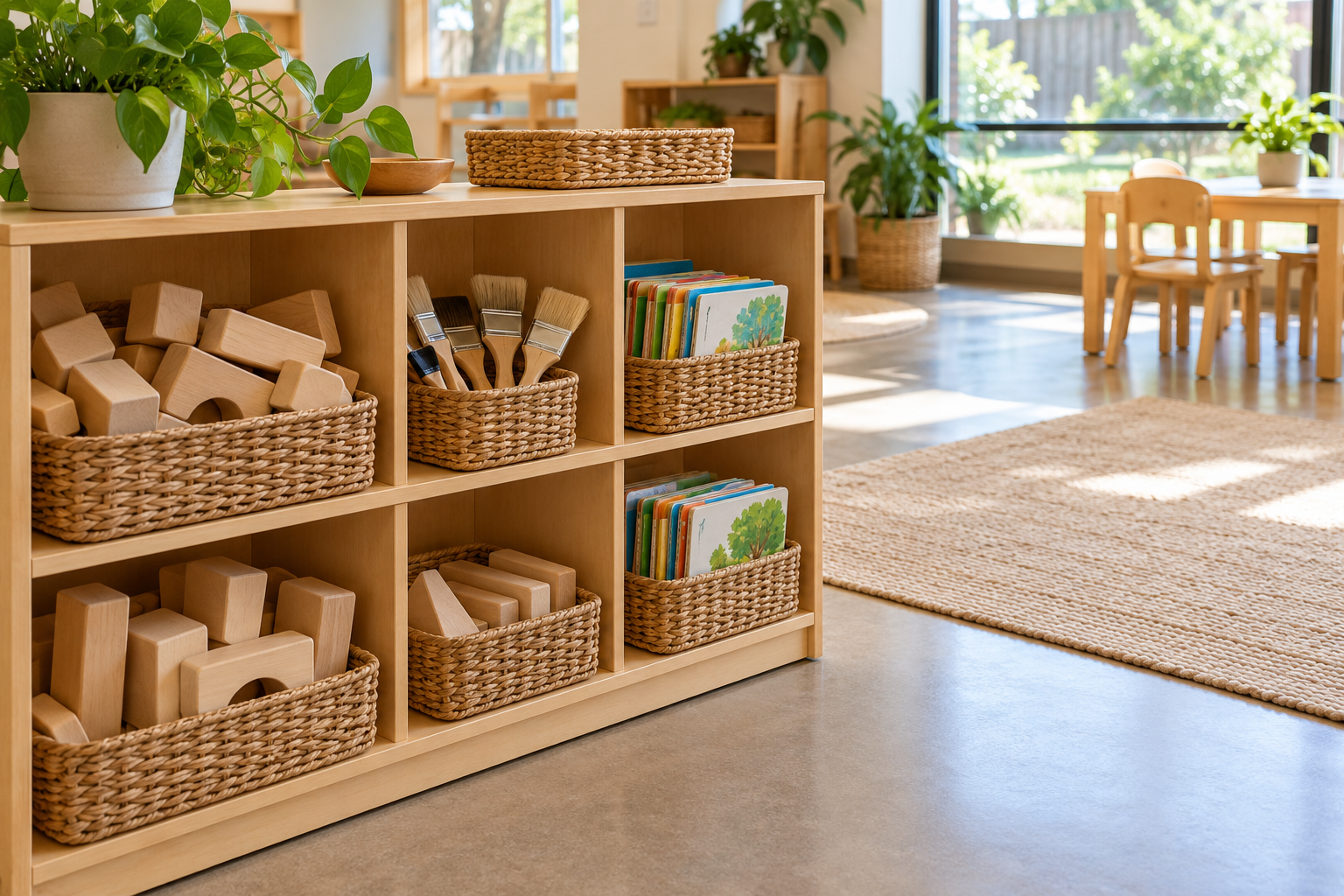
A support stops being dependable when the needed piece is missing, damaged or still drying. Give each shared item a storage place and an adult responsible for its care. Follow manufacturer instructions and the program's hygiene procedures. For JenneTastic, the verified guide calls for appropriate cleaning and complete drying before storage. Staff should also inspect the setup and condition before use, rather than assuming yesterday's arrangement remains suitable today.
Prefer materials whose maintenance the program can actually sustain. A washable activity tool may be easier to manage than a complex assortment of fabrics and loose pieces. Confirm whether an item can be cleaned as required without damage, and decide how it will be taken out of use if needed. The storage arrangement should make it easy to see whether the resource is ready, not invite hurried staff to search through an unlabelled pile.
Plan for shared items between rooms. Moving a resource may change who is responsible for inspection, setup and cleaning. Record the handover through the centre's normal process and preserve the user's guide with the equipment. Do not leave the receiving educator to infer how a product operates from its appearance. If the item cannot be made ready for the next activity, staff need a familiar alternative so the child is not left without an agreed support.
A hypothetical daycare plans a painting choice activity after snack but discovers that all broad brushes were stored wet in a closed container. The immediate answer is an appropriate available alternative; the longer-term answer is a clearer drying and preparation routine. Treat the incident as a logistics issue to fix. A support plan is only as useful as the staff's ability to provide it in a clean, complete and timely form.
Buy a useful resource rather than a complete sensory collection
Start the purchasing discussion with the activity and the gap the team has identified. List what is already available and what could be changed without buying anything. If a product remains useful, describe its intended role: a portable awake pause space, an accessible art tool or a suitable seating option. A resource should earn its place through a clear purpose, not because it appears on a general list of things every daycare needs.
Compare the whole operating cost. Purchase price is only one part; staff preparation, cleaning, storage, replacement and any required training also matter. Ask for current instructions and clarify the supplier's terms before ordering. Do not assume a product is eligible for funding or meets a particular institutional requirement without confirmation. The person approving the purchase needs to understand how it will be used in the actual group and who will maintain it.
For JenneTastic, discuss quantities and ordering through JenneDesign's purchasing options. A centre with several rooms may need to decide whether a shared resource can be available when needed or whether separate units make sense. There is no universal quantity recommendation. Check the program's own process and confirm current pricing, delivery and administrative requirements directly instead of relying on a blog article for an unverified quote.
For other resources, favour selection criteria over a shopping catalogue. Picture cues need to be understandable to the child. Art tools need to suit the task and age. Seating needs to fit the activity and environment. A sound support needs an individual purpose. If a specialist recommends therapeutic equipment, obtain clear guidance for its use and review. A director should be able to explain what the purchase enables, how staff will introduce it and what would lead the team to stop using it.
Read evidence without confusing education with a product trial
Professional guidance can support a thoughtful approach to inclusion without proving that a commercial item produces a particular outcome. NAEYC's discussion of inclusion in infant and toddler settings emphasizes access, participation, collaboration and attention to individual strengths. Those principles help frame daycare decisions. They are not a clinical trial of JenneTastic, and they should not be presented as an endorsement of a particular tent or accessory.
Similarly, NAEYC's article on inclusive early learning environments discusses adjustments to physical surroundings, interactions and the timing of activities. That supports considering the environment and routine as part of planning. It does not establish that every sensory-labelled product improves learning. A director reading a marketing claim should ask which item, population, activity and outcome were actually examined, rather than treating a broad educational principle as product evidence.
The Royal College of Occupational Therapists provides information on sensory approaches, including a March 2026 informed view. Its emphasis on evidence-informed professional practice is relevant when individual sensory concerns affect meaningful activities. Daycare staff should distinguish an environmental adjustment they can implement from a clinical approach requiring professional assessment. A general resource is a starting point for informed discussion, not an individualized treatment plan or a reason to promise results.
Our product discussion therefore stays practical: intended age, indoor use, supervision, storage and whether a child welcomes the option. The program can observe its own experience, but a successful local trial does not prove a general therapeutic effect. For the broader research and product comparison, read our guide to sensory needs in children and the science. This daycare pillar addresses how to organize ordinary care and play, rather than repeat that review.
Review participation and change course when needed

Choose a small number of observations linked to the original goal. If the change concerns arrival, note whether the child can find the first activity and how the handover feels. If it concerns painting, note whether a usable option is available and whether the child chooses it. Do not turn the child's whole day into a score. The review should help adults decide what to keep, adapt or stop.
Include staff implementation in the review. An adjustment may appear ineffective because it was not ready, the responsible adult was unavailable or the next activity was unclear. Those are different findings from a child consistently rejecting a well-prepared option. Record the practical context so the team does not blame the child for a routine it could not reliably provide. A resource that requires more preparation than the centre can sustain may need replacing with a simpler arrangement.
Listen to refusal as information. The child's preference may change, an activity may have lost its interest or the support may feel uncomfortable. Revisit the goal with the family and relevant staff. If the original difficulty remains significant, consider whether additional professional advice is needed. Removing an unsuitable item is not abandoning support; it can be part of improving the plan and protecting a child's ability to express what works for them.
A hypothetical centre introduces a quieter snack place for a child who dislikes crowding. After a week, the child chooses the usual table because their preferred peer sits there. Staff might then adjust seating within that table rather than insist on the quieter place. The observation shows why participation and relationships belong in the review. Less noise is not automatically the most valuable outcome if the arrangement removes something the child wants from the activity.
A practical checklist for the next care day
Before the children arrive, select one routine to improve and confirm who will prepare it. Identify the child's goal in ordinary language, check that the materials are available and review the adult's position. A short preparation check can prevent a well-intentioned plan from becoming another promise staff cannot fulfil. Start with a manageable adjustment and a date to discuss what happened, rather than announcing a whole-room transformation at once.
Use the following checklist as a working prompt for the staff conversation. Adapt it to the program's requirements and the child's established care plan. It is not an inspection standard or a replacement for licensing guidance. Its purpose is to make the everyday decisions visible so adults can identify what is missing before the activity begins.
Name the activity the child wants to access and the specific part that is difficult.
Confirm the child's usual ways of showing interest, refusal, help and completion.
Choose one feasible change to the environment, timing, adult support or materials.
Check age suitability, manufacturer instructions, individual needs and program procedures.
Prepare the resource, its storage place and the adult's supervision arrangement.
Make the invitation understandable and provide an available alternative if it is declined.
Decide what happens after a pause or when the activity ends.
Share the plan with relevant educators, including the substitute or afternoon provider.
Record a brief observation about participation and whether the adults could deliver the plan.
Review with the family, retain what helps and revise what does not.
At the end of the care day, check whether the arrangement was genuinely available and whether it served the intended activity. Include one useful success and one unresolved question in the handover. The next step may be a modest change, such as preparing the materials earlier or offering a different way to join. Progress does not require accumulating products; it requires adults to act on what they learn about the child's experience.
Questions families and daycare teams often ask
Does a child need a diagnosis before the daycare makes adjustments?
Ordinary considerate adjustments can begin with a specific observed need: making an instruction clearer, offering an appropriate tool or reducing unnecessary waiting. Staff should stay within their role and program procedures, without diagnosing the child or prescribing treatment. Persistent or substantial concerns deserve discussion with the family and appropriate professionals. The support should address access to the activity, and the team should explain what it is trying and how it will be reviewed.
Is JenneTastic suitable for every child in a daycare?
No. Its verified age guidance is three years and older, with indoor use, adult supervision and the exit clear. Even within that age group, a child's preference, access needs and the room's supervision arrangement matter. It is a temporary awake pause option, not equipment for babies, a nap space or active play. Review the current guide and consider an open alternative if the tent does not fit the child or the setting.
How many products should we introduce at the beginning?
Begin with a clear goal and a manageable change. Several new resources introduced together make it harder to understand what the child actually uses and what staff can maintain. Existing materials or a timing adjustment may be enough for the first trial. If another resource is needed, add it for a defined purpose and review the new arrangement. A centre does not need a complete sensory collection to start improving an everyday routine.
What if a child never chooses the calm space?
Do not force the choice or assume the child is refusing help. The invitation, location or activity may not suit them, or they may prefer support within ordinary play. Ask what they do choose and revisit the original goal. Staff can offer a different manageable option while keeping appropriate care and supervision. A product is useful only when it fits a real need; its presence should not dictate how the child must participate.
Should home and daycare use exactly the same routine?
Share information and preserve familiar meanings where useful, but account for the different spaces, adults and groups. A home routine may require adaptation before it can work in daycare. The family and educators can agree on a few recognizable cues and explain any differences. Consistency should make the child's experience understandable, rather than require a provider to copy an arrangement that is impractical or unsuitable for the childcare setting.
Where does this guide fit with the other JenneDesign articles?
This pillar covers childcare routines, play, age suitability and adult coordination. Our sensory supports at home guide addresses family routines and shared living spaces. Our school and classroom guide focuses on learning access and school implementation. Use the guide that matches the setting, and bring relevant questions to the child's family and support team rather than applying every suggestion everywhere.
Build a daycare day that children can take part in
A useful sensory-support plan is visible in ordinary moments: a welcoming arrival, an accessible play invitation, a manageable meal, considerate personal care and a clear transition. It gives adults a practical way to respond while leaving the child room to communicate and choose. JenneTastic can be one resource for a supervised preschool pause, alongside an open quiet area, suitable tools and thoughtful changes to the routine.
If your program is considering JenneTastic, contact JenneDesign about your daycare's needs. Describe the ages you care for, the room, the activity you want to support and the way staff would supervise use. That conversation can help clarify the product's practical fit and ordering requirements. Keep the wider goal in view: a program where children can enjoy play, receive considerate care and belong with their peers.