 Creator of JenneTastic®
The pretend kitchen is serving breakfast to a line of stuffed animals. Across the room, children are rolling vehicles down a ramp. One child has spent the morning moving between both games. Now they approach their educator.
“I want to sit with you.”
A daycare day can include that quieter moment alongside the activity around it. A child may want a little company, fewer conversations or time without another game to join.
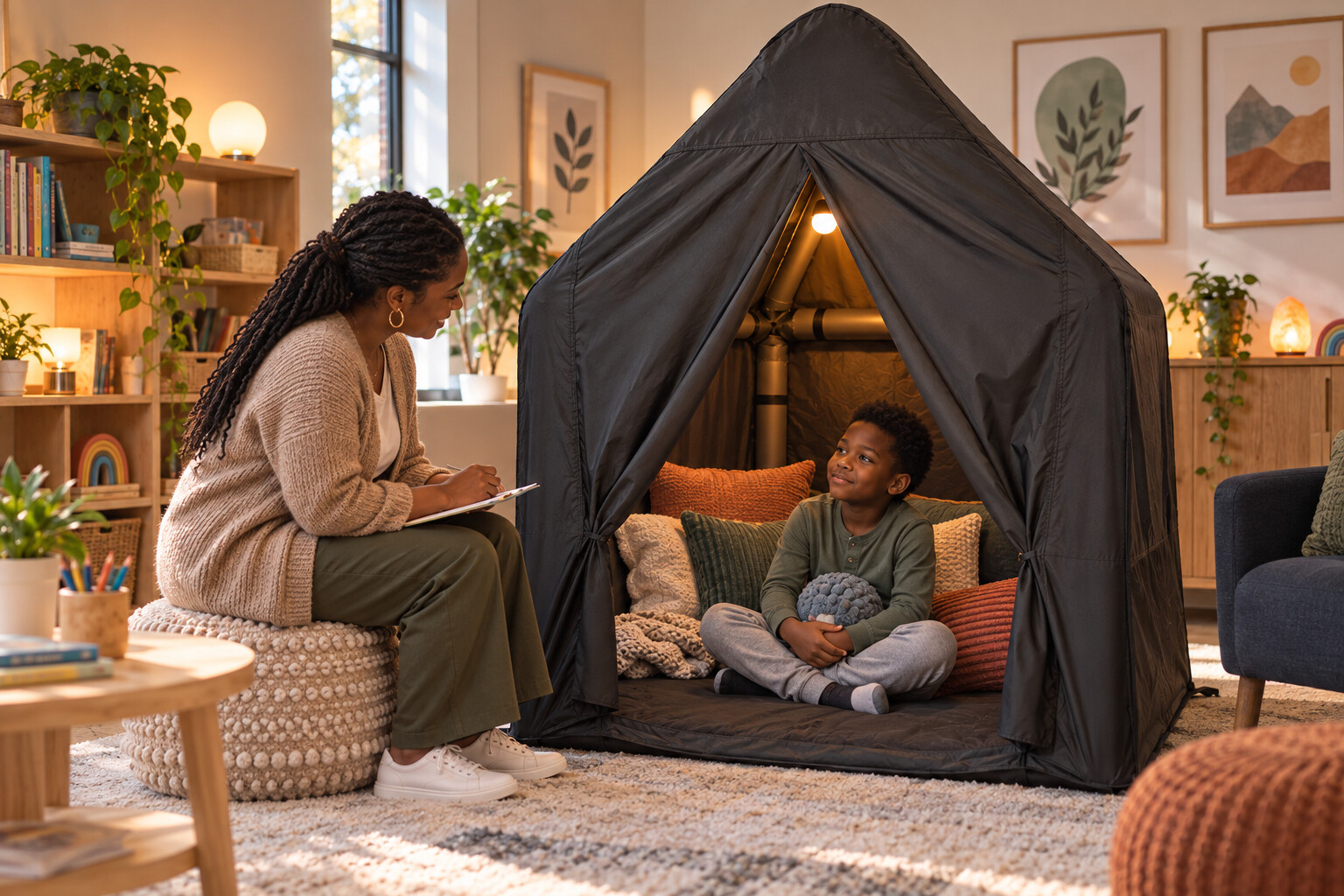
JenneTastic is a portable, inflatable sensory tent that can offer a defined indoor space for a voluntary pause under constant adult supervision. In daycare, its practical role is to make that option available during awake time for children aged three and older.
The child can choose a pause without being sent away, required to sleep or expected to complete an activity inside.
In this article
A Pause Does Not Need an Activity
Let the Child Lead the Conversation
A Quiet Moment After Pretend Play
Keep Quiet Time Separate From Sleep
Keep the Tent Out of Pretend Adventures
Offer It During Free Play Without Making It Another Station
Leave Rewards and Consequences Elsewhere
Notice What the Child Actually Chooses
Before Introducing JenneTastic to Your Group
Considering JenneTastic for Your Daycare
A Pause Does Not Need an Activity
Daycare rooms offer plenty to do. There are materials to explore, songs to sing and invitations to join other children.
A pause can leave those invitations aside for a moment.
If a child chooses JenneTastic, an educator does not need to immediately offer a puzzle, ask questions or begin a story. The child may simply want to sit while a familiar adult remains nearby.
Ask one practical question if it is helpful:
“Would you like to talk, or shall we sit for a moment?”
Then follow the answer. A child might start talking after a while, or they might say very little before deciding they are finished.
Avoid filling the time with instructions about breathing, counting or demonstrating calmness. Unless an individual plan calls for a particular approach, the pause does not need to become an adult-led exercise.
An empty space is not an unfinished activity. If the child wants nothing added, you can respect that preference while maintaining supervision.
If they do ask for something familiar, follow the product guidance for anything brought into the tent. Keep the choice small enough that the space remains available for the purpose the child requested.
Let the Child Lead the Conversation
An educator can be attentive without directing every exchange.
A child may talk about the morning’s game, mention a family member or point towards something happening in the room. Respond to what they bring up rather than turning the conversation into a check of why they wanted a pause.
For example:
“We made pancakes for the bear.”
“You were cooking in the kitchen this morning.”
That acknowledgement leaves room for the child to continue. It does not ask them to account for leaving the game.
Some children will want more conversation. Others may use gestures, pictures or their usual communication device. Keep those methods available so they can ask for help, company or an end to the pause.
If a child describes something upsetting, listen and respond through the daycare’s usual practices. The tent does not replace the educator’s responsibility to help. It can provide the setting for a quiet moment, while the adult attends to what the child communicates.
There is also no requirement to talk. Staying available can be enough.
A Quiet Moment After Pretend Play

Here is an imagined example.
A child has been playing in the pretend kitchen with several others. The game grows lively as children bring over more toys and decide who will serve each meal.
The child leaves the game and approaches an educator who is available to supervise.
“I want to sit with you.”
The educator offers a quieter moment at JenneTastic. The child chooses to use the space, and the educator stays nearby.
They do not bring an activity. For a short while, the child sits without conversation. Then they begin talking about the pretend breakfast.
“The bear wanted all the food.”
The educator listens. The child tells them how the animals were seated and who made the pancakes. There is no question about whether the child is calm yet and no task to finish before leaving.
Eventually, the child notices another educator setting out drawing materials.
“I want to draw the bear.”
They leave the tent and go to the drawing table, with the help they ordinarily need.
The pause did not have to produce a visible transformation. The child asked for quiet company, received it and chose their next interest.
Another child might ask for the same kind of company beside an educator elsewhere in the room. JenneTastic remains an option rather than the required setting for every quiet interaction.
Keep Quiet Time Separate From Sleep
Daycare routines often include both quiet activities and a scheduled rest period. Make JenneTastic’s purpose clear: it is for temporary use while the child is awake.
Do not present it as a place to nap or as an alternative to appropriate sleep equipment. Follow the daycare’s established arrangements for rest and sleep.
The distinction matters in how adults describe it. “You can have a quiet pause here” means something different from “Go and have a rest in the tent.”
Explain that difference to staff and families before regular use. Otherwise, one person may offer an awake pause while another assumes that a child can stay there to sleep.
If a child appears sleepy or says they want to sleep, respond through the daycare’s normal rest arrangements. Do not extend the tent’s use to accommodate sleep.
Avoid placing bedding inside to make it resemble a sleeping area. Use the current product instructions to determine what belongs in the space.
A quiet pause can be part of the awake day without becoming part of the sleep routine.
Keep the Tent Out of Pretend Adventures

Children may see a tent and imagine a house, cave or hiding place. That curiosity is understandable, especially in a room full of pretend play.
Explain its use in concrete words:
“This is our pause space. We do our running and adventure games over there.”
JenneTastic is not intended for active play. Do not encourage chasing through the opening, climbing or games that turn access into a contest.
The educator can redirect an idea without dismissing it. If children want to pretend they are camping, that interest can be explored in an appropriate play area with suitable materials.
Keep the purpose consistent across adults. Calling the tent a quiet pause space in the morning and a fort in the afternoon creates conflicting expectations.
If children repeatedly approach it for energetic play, review how it is being presented. Posters, props or a themed introduction may be inviting the very activity staff keep interrupting.
A straightforward name and explanation can help children understand what is available.
Offer It During Free Play Without Making It Another Station
Free play gives children opportunities to choose among activities. A pause space can be available within that period without becoming a station everyone is expected to visit.
Do not add JenneTastic to a rotation in which every child must take a turn. That would make participation a requirement rather than a choice.
An educator might say:
“If you want a quiet moment, you can ask me.”
Some children will use the option. Others will remain interested in their games. Neither response needs to be treated as an achievement.
A child who approaches the space out of curiosity may need a brief explanation before deciding. Show them the opening and how to leave, following the guide. Avoid encouraging them to enter simply because other children have tried it.
Availability also depends on supervision. Before offering the space, make sure an adult can remain responsible for the child while the rest of the group receives appropriate care.
When that arrangement is not possible, respond to the request with another suitable option. A tent being prepared in the room does not mean it can be offered at every moment.
Leave Rewards and Consequences Elsewhere
A child should not need to earn a pause by finishing a craft, eating a particular food or following an adult’s preferred version of a game.
Likewise, JenneTastic should not be where an educator sends a child after a disagreement.
Keep the invitation separate from the issue that needs attention. If children have argued over a toy, adults can help address that conflict without making the tent the place where someone must apologize.
Avoid phrases such as “You can come out when you’re ready to behave.” They turn the space into a consequence and make leaving depend on an adult’s judgement.
A child may choose a pause after a difficult interaction, but that is different from being directed into one. The educator remains responsible for providing support and responding to the situation.
The entrance and exit must stay unobstructed. Never prevent a child from leaving or require them to remain until they display a particular mood.
Notice What the Child Actually Chooses

A useful description of the experience stays close to what happened.
“The child asked to sit quietly with an educator, used the space without an activity and later chose drawing.”
That tells the team how the child used the option. “The tent calmed them down” claims more than the observation establishes.
Notice whether children are asking for quiet company, declining the space or treating it as play equipment. Those responses help you decide how to offer it and whether its current use is clear.
An educator may find that the child wants conversation but prefers sitting outside. Another child may choose the tent only when the room is especially busy. There is no need to encourage more frequent use to justify having the product.
Keep any observations brief and relevant to the daycare’s ordinary practices. The purpose is to understand the child’s choices, not to measure their performance during a pause.
Before Introducing JenneTastic to Your Group
Check the daycare’s requirements for equipment, room access and supervision before introducing the tent. Plan for the child using it and the other children in the room.
JenneTastic is recommended for children aged three and older, under constant adult supervision. It is intended for temporary indoor use while awake, not sleep or active play. An adult operates the pump.
Read the current FAQ and user guide for placement, setup, inspection, cleaning and storage. Agree which adults will carry out those tasks.
JenneTastic offers a defined space for a voluntary pause. It is not a treatment and does not guarantee a particular response.
Considering JenneTastic for Your Daycare
Think about the use your team can offer: a child choosing a quieter moment during awake time, with an educator available and no activity they must complete.
For more information, explore JenneDesign’s page for daycares, then view the JenneTastic kit and ordering options.